
“Nature itself is the best physician.”
Hippocrates
Simply being in nature – whether it’s in a forest, park, garden, river, or even a tree-lined neighborhood – has many health benefits. It:
- Lowers stress
- Calms the nervous system
- Boosts memory, cognitive function, and wellbeing
- Improves immune function
- Resets negative thinking
- Boosts creativity
Even though researchers have found that being in nature supports both physical and mental health, they are still not quite sure why. The good news is that you don’t have to spend hours outdoors to experience the benefits. Studies suggest that as little as 120 minutes per week (just 17 minutes a day) already has a positive impact on your overall health and wellbeing.
Why Forest Bathing Is so popular
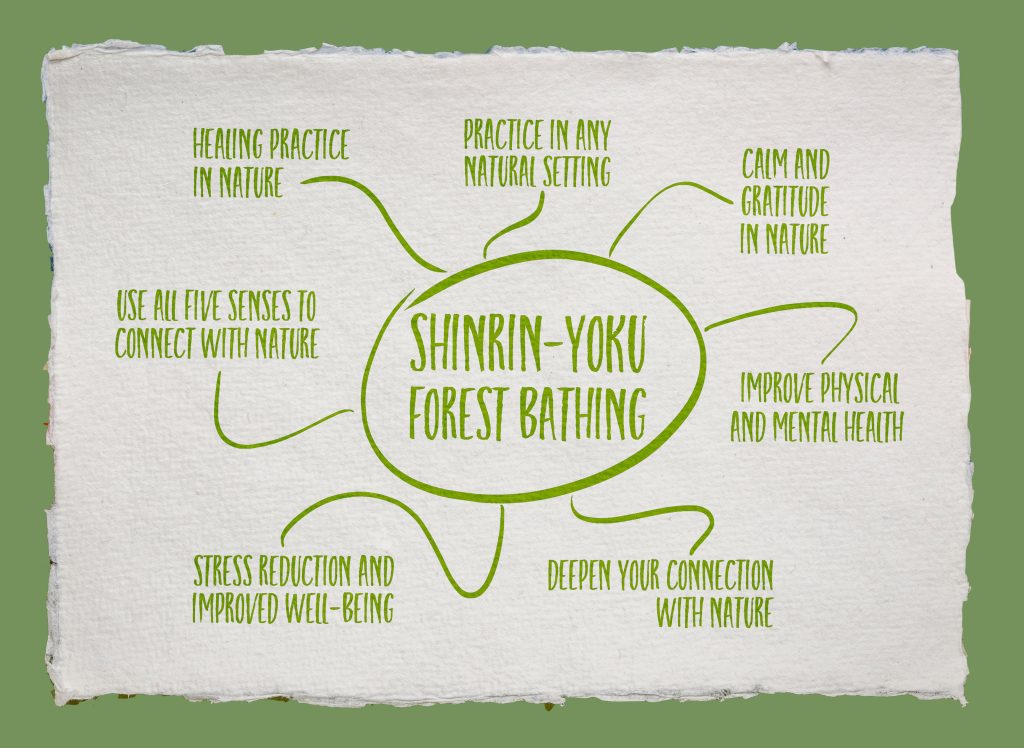
Just being in nature, even if only sitting by a river or in a forest, has a calming effect. People in Japan call it Shinrin-yoku, or forest bathing, which has gained much popularity over these last years.
Shifting from the busy-ness of daily life to using our physical body and five senses in nature brings us back into the Here and Now. Breathing becomes slower, the heart rate lowers, we relax. Any anxiety falls off and the mental focus is on physical reality, which gives the brain a rest. Eyes become soft, tunnel vision goes away, and we can take in more information from the periphery. In fact, being in nature has some of the same effects as meditation [link to braintap article]: it quiets the mind, reduces mental chatter, and activates the parasympathetic nervous system (“rest and digest”).
Feelings of connectedness and awe
Experiencing nature can also bring out deep feelings of awe, connectedness and gratitude – for instance by looking up a giant redwood tree, hiking up a mountain and seeing the landscape underneath, stopping to really look at a little flower on the path, seeing young animals play, watching a sunset… the opportunities are endless and often leave us with a feeling of awe and well-being.
Use the morning sunlight to ‘reset your inner clock’ daily
Specialized light-sensitive cells in the retina, when exposed to morning light, tell the body to suppress melatonin and increase cortisol to help us start the day with increased energy and focus. They also set the clock to start melatonin production again 14 – 16 hours later, which helps with sleep the next night.
Morning light can also improve mood and metabolism. All it takes is 10-20 minutes of natural and unfiltered light exposure – ideally half an hour to an hour after waking up in the morning.
Ways to catch that morning light:
- Have your morning coffee and /or breakfast outside
- Step out on the porch to plan for the day
- Water the garden
- Take a walk before work
Vitamin D – The Sunshine Vitamin
And of course being outside increases exposure to light, which in turn boosts vitamin D production – which is essential for many functions in the body:
- Bone health
- Immune function and activity
- Muscle strength
- Mood and brain health
- Improved sleep
- Heart health
- Blood sugar regulation
- Skin health
With our modern, indoor-focused lifestyle, vitamin D deficiency has become increasingly common. Low vitamin D levels can contribute to fatigue, frequent illness, slower wound healing, and other health concerns. A simple blood test can determine whether you are getting enough.
Conclusion
Being in nature regularly is an essential part of a healthy lifestyle. It is a simple yet powerful way to support your body’s natural ability to heal and thrive – and it doesn’t cost anything!
Simple ways to get more nature this month (even if you’re working):
- Eat breakfast or lunch outside
- Walk after dinner
- Sit with your bare feet in the grass
- Visit a local park
- Go swimming, rafting, or wading in a river
- Sit under a tree and simply notice what you hear, see, and feel
- Tend a garden – even a few potted herbs count
- Take the kids or grandkids on a scavenger hunt
- Volunteer at a park or community garden
- Attend to or start a neighborhood seed or plant exchange
- Pick your own fruit at a farm
- Have a picnic with friends or family
- Watch the sunrise or sunset
Written by Karen Wegehenkel
Sources
Dr. Mercola: Time in Nature Provides a Host of Health Benefits
https://articles.mercola.com/sites/articles/archive/2018/07/26/benefits-of-time-in-nature.aspx
Dr. Mercola: Most Americans Suffer From Nature Deficiency Syndrome
https://articles.mercola.com/sites/articles/archive/2024/02/20/ecotherapy.aspx
Mathew P White, Ian Alcock, James Grellier, Benedict W Wheeler, Terry Hartig, Sara L Warber, Angie Bone, Michael H Depledge, Lora E Fleming:
Spending at least 120 minutes a week in nature is associated with good health and wellbeing
https://pmc.ncbi.nlm.nih.gov/articles/PMC6565732/
Ye Wen, Qi Yan, Yangliu Pan, Xinren Gu, Yuanqiu Liu: Medical empirical research on forest bathing (Shinrin-yoku): a systematic review
https://pubmed.ncbi.nlm.nih.gov/31787069/